<!DOCTYPE html>
<html>
  <head>
    <meta http-equiv="Content-Type" content="text/html; charset=UTF-8">
  </head>
  <body>
    <p>The attached is an updated and expanded sample demonstrating the
      approach I am trying to use for the documentation that I am
      compiling (instance of HTML page for PRE_raw_t3.html which is for</p>
    <ul>
      <li>DROP at raw table within PREROUTING chain.</li>
    </ul>
    <p>If you drop that file into the same directory into which the
      other files from my previous email were stored, it will be
      accessible by clicking on that cell in the index grid.</p>
    <p>I am debating whether to add a click button to expand the
      documentation iframe to fill the viewport and click again to
      restore/close the documentation.</p>
    <p>I would again invite observations, comments and suggestions
      regarding this approach to ensure that I am serving the widest
      audience possible by the resulting documentation set, but keep in
      mind that the intended audience is truly the individual trying to
      master the complexity of </p>
    <ul>
      <li>a home-based desktop computer's firewall.</li>
    </ul>
    <p>I didn't do so with this incarnation of the document page
      (template), but eventually it should have visible prompts, icons
      or coloured words, to make stand out which elements are relevant
      to each of the two distinct contexts that I envisage:</p>
    <ul>
      <li>personal desktop computer, and</li>
      <li>shared server.</li>
    </ul>
    <p>Again, I thank you in advance for your feedback.</p>
    <p><br>
    </p>
    <p>Eric</p>
    <p><br>
    </p>
    <div class="moz-cite-prefix">On 2026-08-08 23:20, Eric Marceau via
      linux wrote:<br>
    </div>
    <blockquote type="cite"
      cite="mid:20260809032046 [ dot ] 3056520C38 [ at ] mail [ dot ] linux-ottawa [ dot ] org">
      <meta http-equiv="content-type" content="text/html; charset=UTF-8">
      <p>Hello,</p>
      <p>I am about to rework my homebuilt firewall scripts using
        IPTABLES (I am aware nftables is out there).  It is intended for
        a personal desktop computer.</p>
      <p>However, in preparation for that, I am also reworking the
        documentation I have about IPTABLES into something I would
        consider more useful for myself, that what I have seen in
        various places on the Internet.</p>
      (... snip ...)
      <p>As an example of my approach, one of these indexing pages, for
        the "forwarding" stream, is attached.  I also include here a
        snapshot of what that looks like:</p>
      <blockquote>
        <p><img src="cid:part1.NRu0zoY0.caxg0byJ@rogers.com"
            moz-do-not-send="false" class=""></p>
      </blockquote>
      (... snip ...)</blockquote>
  </body>
</html>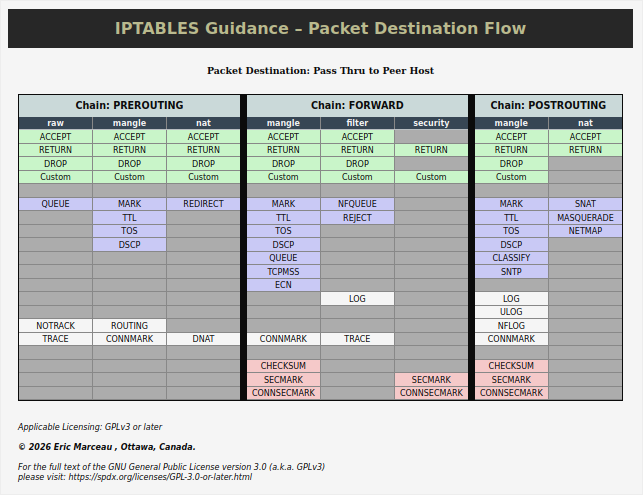
<!DOCTYPE html>
<html lang="en">
<head>
	<meta charset="UTF-8">
	<meta name="viewport" content="width=device-width, initial-scale=1.0">
	<title>Guidance for Selecting DROP as Target for PREROUTING Packets Evaluated at raw Stage</title>

	<style>
body {
	background-color:			#2F2F2F ;
	color:					light-blue ;
	font-family:				"Liberation Sans", "Aileron", "Archivo", FreeSerif, serif ;
}

.popup_banner{
	background-color:			#BFFFBF ;
	color:					black ;
	margin:					0px ;
	padding:				10px ;
	text-align:				left ;
	font-size:				20px ;
	font-style:				900 ;
}

.popup_guidance{
	/* used for "guidance text displayed in popup window */
	color:					#CFCFFF ;
	margin:					30px 14px 0 14px ;
	text-align:				justify ;
	font-size:				18px ;
	line-height:				26px ;
}

.purpose{
}

.highlights{
}

.typicalSolns{
}

h3{
	margin:					0px ;
	margin-top:				0px ;
	padding:				0px ;
	color:					#FFFFFF ;
	font-style:				normal ;
}

h4{
	color:					orange ;
	margin:					0px ;
	padding:				3px ;
	font-style:				normal ;
	font-weight:				bold ;
	margin-bottom:				0 ;
}


.highlights{
	margin:					0px ;
	margin-top:				30px ;
	h3{
		color:				orange ;
	} ;
	.strategies{
		color:				light-blue ;
		background-color:		#3F3F3F ;
		margin:				20px 20px 40px 20px ;
		padding:			3px 10px 3px 10px ;
		border:				1px solid #000 ;
		border-radius:			8px ;
		box-shadow:			3px 4px 10px rgba(255, 255, 120, 0.7) ;
		p{
			margin:			3px ;
			margin-left:		10px ;
		} ;
		h4{
			color:			#DFDFDF ;
		} ;
	} ;
}

.typicalSolns{
	margin:					0px ;
	margin-top:				30px ;
	h3{
		color:				#FFDF6F ;
	} ;
	.scenarios{
		color:				light-blue ;
		background-color:		#3F3F3F ;
		margin:				20px 20px 40px 20px ;
		padding:			3px 10px 3px 10px ;
		border:				1px solid #000 ;
		border-radius:			8px ;
		box-shadow:			3px 4px 10px rgba(120, 255, 120, 0.7) ;
		p{
			margin:			3px ;
			margin-left:		10px ;
		} ;
		h4{
			color:			#DFDFDF ;
		} ;
	} ;
	.code{
		background-color:		#383838 ;
		color:				white ;
		margin:				20px ;
		padding:			3px 10px 3px 10px ;
		border:				1px solid #000 ;
		pre{
			max-width:		100% ;
			white-space:		pre-wrap ;
			word-break:		normal ;
		} ;
	} ;
}

	</style>
</head>
<body>
	<div class="popup_banner">
		<b>GUIDANCE</b> - Choosing
		<b>DROP</b> as Target for PREROUTING Packets Evaluated at
		<i>raw</i> Stage
	</div>
	<div class="popup_guidance">
		<i>( Target Cell: PRE_raw_t3 - dummy content for purposes of demonstration )</i><br/><br/>

		<div class="purpose">
Core purpose, for using the DROP target in the <i>raw</i> table's PREROUTING chain, is
<ul><li>to discard malicious or unwanted packets</li></ul> before consuming memory for connection tracking. By doing so, it limits the negative impact on CPU and Memory resources during DDoS attacks or high-traffic floods.
		</div>

		<div class="highlights">
<h3>Core Scenarios for Early DROPing</h3>

<div class="strategies">
<h4>Extreme DDoS / SYN Floods</h4>
<p>Stopping volumetric packet floods
at the earliest network driver hook
prevents the kernel state table
from filling up with half-open
connection entries.<p>
</div>

<div class="strategies">
<h4>Bogon / Invalid IP Filtering</h4>
<p>Dropping packets that arrive with
unroutable, private, or reserved source IPs
(e.g., RFC 1918 space on a public interface)
before any processing occurs.<p>
</div>

<div class="strategies">
<h4>Stateless Edge Security on High-Bandwidth Routers</h4>
<p>Implementing high-performance line-rate
packet drops on heavy 10GbE+ interfaces
where state tracking overhead is too
expensive.<p>
</div>

<div class="strategies">
<h4>Pre-Routing Blacklisting</h4>
<p>Discarding traffic from known
malicious actors or active botnet
IPs straight at the boundary
before routing lookups or
NAT evaluations take place.<p>
</div>
		</div>

		<div class="typicalSolns">
<br/>
<h3>Methods to Address Anticipated Scenarios</h3>

<div class="scenarios">
<h4>Extreme DDoS / SYN Floods</h4>
<p>To mitigate high-volume SYN floods, you can pair the early DROP target with the limit or hashlimit module to allow legitimate traffic while dropping abusive volumetric spikes.<br/>
<br/>
Sample form(s) of command:
</p>
<div class="code"><pre>iptables -t raw -A PREROUTING \
	-p tcp --syn \
	-m hashlimit \
	--hashlimit-above 100/sec \
	--hashlimit-burst 150 \
	--hashlimit-mode srcip \
	--hashlimit-name syn_flood_limit -j DROP</pre>
</div>
<p>
This works because it tracks incoming <b>SYN</b> packets per source IP (srcip). If a single IP exceeds 100 SYN packets per second (with a burst 'headroom' of 150), any additional SYN packets from that IP are immediately dropped at the raw chain before they can consume limited resources.</p>
</div>


<div class="scenarios">
<h4>Bogon / Invalid IP Filtering (WAN-facing Only)</h4>
<p>
Bogon IPs are addresses that should never appear on the public internet (such as private, loopback, or reserved subnets). If your server is connected to a public-facing interface (not your organization's private LAN), you should drop these instantly.<br/>
<br/>
Sample form(s) of command:
</p>
<div class="code"><pre>
# Drop private RFC 1918 networks arriving on public eth0
iptables -t raw -A PREROUTING -i eth0 -s 10.0.0.0/8 -j DROP
iptables -t raw -A PREROUTING -i eth0 -s 172.16.0.0/12 -j DROP
iptables -t raw -A PREROUTING -i eth0 -s 192.168.0.0/16 -j DROP

# Drop loopback spoofing and APIPA/link-local autoconfiguration
iptables -t raw -A PREROUTING -i eth0 -s 127.0.0.0/8 -j DROP
iptables -t raw -A PREROUTING -i eth0 -s 169.254.0.0/16 -j DROP

# Drop multicast and reserved experimental spaces
iptables -t raw -A PREROUTING -i eth0 -s 224.0.0.0/4 -j DROP
iptables -t raw -A PREROUTING -i eth0 -s 240.0.0.0/4 -j DROP</pre>
</div>
<p>
It is important to note that many of the address ranges, being blocked for WAN-originating packets, are in fact ranges which are to be expected at your computer interface if the computer is on a private LAN, in which case it is strongly inadvisable to block these, except for special circumstances.</p>
</div>


<div class="scenarios">
<h4>Stateless Edge Security on High-Bandwidth Routers</h4>
<p>If your high-bandwidth server or router provides a specific stateless service (like public DNS over UDP) but should absolutely never accept traffic on high-traffic ports (like standard web servers or internal database servers), you can drop that traffic statelessly, in order to avoid wasting CPU cycles.
<br/>
<br/>
Sample form(s) of command:
</p>
<div class="code"><pre class="wrapIndent"># Statelessly drop all incoming HTTP/HTTPS traffic
iptables -t raw -A PREROUTING -p tcp --dport 80 -j DROP
iptables -t raw -A PREROUTING -p tcp --dport 443 -j DROP

# Statelessly drop unapproved high-volume UDP ports
#   (e.g., custom game ports or NTP reflection vectors)
iptables -t raw -A PREROUTING -p udp --dport 123 -j DROP</pre>
</div>
</div>


<div class="scenarios">
<h4>Pre-Routing Blacklisting</h4>
<p>When an external IP or subnet is actively attacking your infrastructure, scanning ports, or acting as a known botnet node, you can hard-ban them at the absolute perimeter.
<br/>
<br/>
Sample form(s) of command:
</p>
<div class="code"><pre># Drop a specific malicious single attacker IP
iptables -t raw -A PREROUTING -s 203.0.113.50 -j DROP

# Drop an entire rogue /24 subnet or hosting provider
#   known for spam/attacks
iptables -t raw -A PREROUTING -s 198.51.100.0/24 -j DROP</pre>
</div>
<p>Note that this is where each of <b>Whitelists</b> and <b>Blacklists</b> would be strategically managed using the <b>ipset</b> functionality of iptables.<br/>
<br/>
<b><span style="color: yellow">FUTURES:</span> Add expanded examples demonstrating the application of ipsets, as well as doing so without affecting active functional connections.</b>
<br/>
</p>
</div>


		</div>
	</div>

</body>
</html>